
Every executive conversation I have right now hits the same speed bump.
People know Copilot exists. Many have tried it. Some even love it.
But when the conversation turns to Work IQ or Copilot Cowork, I get the same look, and the same question:
“So… what changed?”
Here’s my simplest answer, and it’s the one that I think is landing with audiences:
Phase 1a (Copilot) Do what you do, better and faster, with an AI assistant.
Phase 1b (Copilot + Work IQ) Do what you do, better and faster, with a thought partner that understands your work and helps you make better decisions.
Phase 1c (Copilot + Work IQ + Cowork) Do what you do, better and faster, with a thought partner that helps you make better decisions, plus a coworker that turns intent into execution across Microsoft 365.
That’s the whole story.
Now let me unpack why it matters.
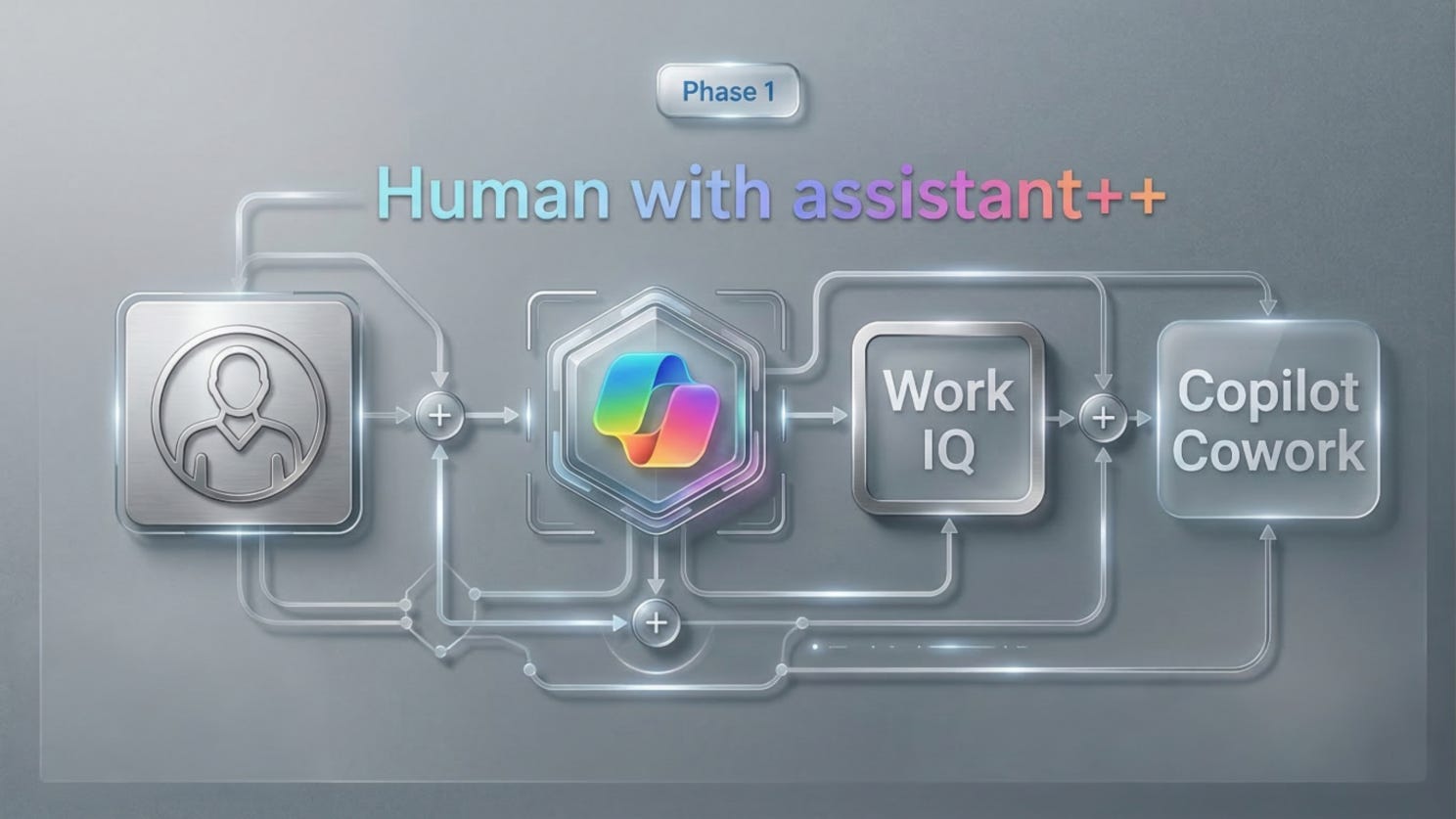
Phase 1a: Copilot as an assistant (useful, but still “you do the work”)
Phase 1a is where most organizations are today.
Copilot helps you draft, summarize, brainstorm, and get unstuck faster. It’s real productivity, but it’s still fundamentally prompt → response. The human stays responsible for stitching together the steps.
If you’ve ever thought, “This is helpful, but I still have 14 clicks to go,” you’re not alone.
That’s exactly why Phase 1b exists.
Phase 1b: Work IQ is the “So what?” behind Copilot
Work IQ is the part most people don’t understand yet, and it’s also the part that quietly changes everything.
The easiest way to think about Work IQ is this:
Work IQ isn’t another feature. It’s the reason Copilot feels like it knows what you mean.
It’s the intelligence layer that personalizes Copilot to you and your organization. It understands context, relationships, and work patterns so Copilot can be faster, more accurate, and more relevant to how work actually gets done.
At a high level, Work IQ is built on three ideas:
Data grounding in your work Signals from emails, meetings, chats, files, and business data, always respecting permissions and governance.
Context that evolves It learns how people collaborate, what matters most, and how work flows over time, not just what’s written in a single document.
Skills and tools Specialized capabilities that help Copilot do specific tasks more reliably, and tooling that executes those intents.
This is why the conversation is shifting from “Copilot can write content” to “Copilot can help me decide what matters next.”
But even with better context, there’s still a ceiling.
You still have to do the follow-through.
That’s where Phase 1c comes in.
Phase 1c: Copilot Cowork, the shift from answers to execution
Copilot Cowork is the moment Copilot stops being only an assistant and starts acting more like a digital teammate.
Instead of just answering questions, Cowork is built to take action.
You describe the outcome you want. Cowork grounds the work in your emails, meetings, messages, files, and data. Then it turns your request into a plan.
That plan runs in the background, with clear checkpoint while you continue to do other work.
You stay in control:
Cowork checks in if it needs clarification
It proposes actions before making changes
You can pause, adjust, or approve at any point
This is a fundamentally different operating model than most AI tools people have experienced.
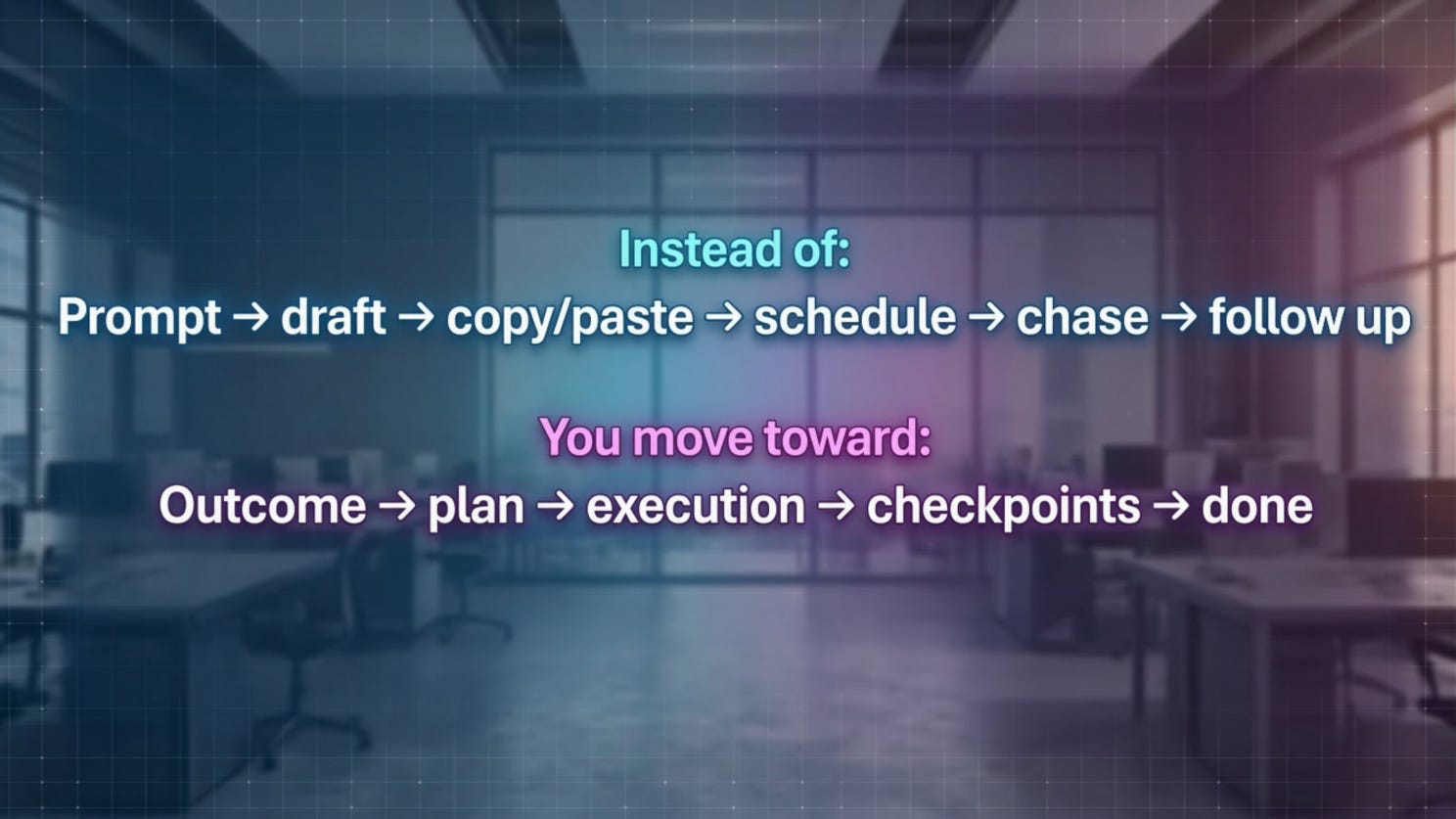
Instead of:
Prompt → draft → copy/paste → schedule → chase → follow up
You move toward:
Outcome → plan → execution → checkpoints → done
Here are a few examples that resonate immediately with leaders:
Cleaning up your calendar by reviewing conflicts and low‑value meetings, then proposing and applying changes after approval
Building a full meeting packet, briefing document, analysis, deck, and follow‑up without stitching together inputs manually
Running deep research and receiving an executive summary, structured memo, and supporting analysis in usable formats
Creating a launch plan that includes competitive intel, value messaging, assets, milestones, and next steps
This isn’t “a better chat window.”
It’s a new workflow pattern.
The executive implication: the work moves from “in your inbox” to “in flight”
This is why I use the Phase 1a / 1b / 1c framing.
Phase 1a improves individual productivity. Phase 1b improves decision quality. Phase 1c improves throughput.
The work doesn’t just get answered. It gets carried forward.
And critically, this happens inside enterprise-grade guardrails: identity, permissions, compliance, auditability, and governance all still apply.
That combination, execution plus control, is the real unlock.
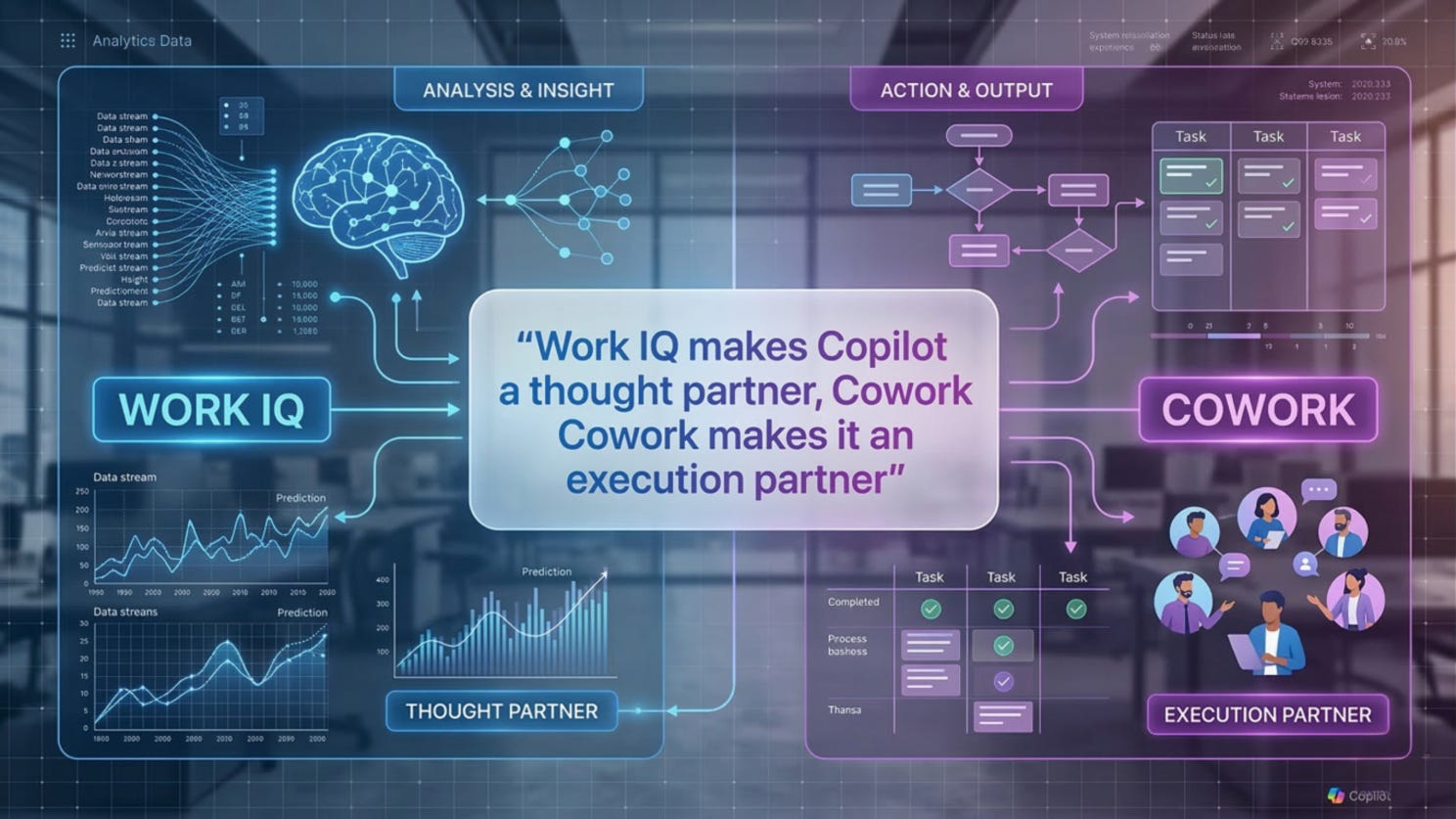
Work IQ makes Copilot a thought partner, Cowork makes it an execution partner
Five questions I’m asking leaders right now
If you’re evaluating where to start, these are the questions I’d put on the table:
Where do we lose the most time to coordination, not writing?
Which workflows are repeatable enough to delegate, but important enough to require checkpoints?
Where would better context materially change decision quality?
How will we measure impact beyond adoption, cycle time and throughput matter more than novelty?
Are we ready for “work in flight”, with visibility and control instead of everything living in inboxes?
Closing thought
For the past year, the AI conversation has been dominated by content generation.
The next conversation is about execution.
Not “Can AI write this?” But “Can AI carry the work forward, safely, while I stay in control?”
If you’re already seeing moments where Copilot feels like it understands context you didn’t explicitly type, you’re seeing Work IQ at work.
And if you’re curious about Cowork, here’s the simplest starting question:
What is one coordination-heavy task you would happily delegate tomorrow, if you could review and approve it at checkpoints?